I start with the child, not an age chart
I cannot choose a useful puzzle from age alone. Children of the same age can have very different experience with touchscreens, visual matching, and frustration. I begin with what the child already enjoys and what they can manipulate comfortably.
My aim is a puzzle that requires attention but still produces visible progress. If nearly every move needs adult correction, I reduce the difficulty. If the child places pieces without examining the image, I increase it a little.
I choose clear, recognisable pictures
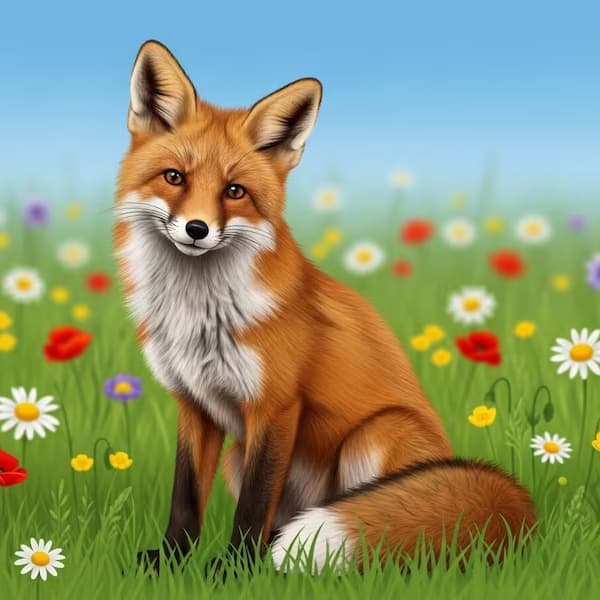
For a first browser jigsaw, I prefer one main subject with strong colour differences. An animal against a meadow is easier to discuss than a dense night market. Clear regions let me give a useful prompt without revealing the answer.
Good starting choices in this collection include:
- Hot Air Balloons, with bright isolated shapes and 25 pieces.
- Red Fox, with a recognisable animal and a distinct background.
- Country Barn, with a bright building, field, and sky.
- Tropical Parrot, when the child is ready for 64 pieces and finer colour changes.
I avoid assuming that a cute subject is automatically easy. Cute Cat is labelled Expert and generates a 144-piece board, so its friendly image does not make it a beginner puzzle.
I treat piece count as an adjustable starting point
I start inexperienced players at the smallest available board. After they complete it, I watch how the solve happened. Did they compare pieces with the reference? Could they recover from a wrong idea? Did they remain interested?
I increase difficulty gradually. A jump from 25 pieces to 144 does not teach persistence; it is more likely to replace a solvable challenge with visual overload. I would move from a clear 25-piece image to a clear 64-piece image before adding complex patterns.
I participate without taking over
When I help, I describe a strategy rather than placing the piece. I might ask:
- Where do you see this colour in the picture?
- Does that line continue anywhere on the board?
- Which area looks easiest to finish next?
- Can you find another piece with the same texture?
These prompts keep the child responsible for the decision. If I drag pieces into place myself, the activity may finish faster, but the child loses the matching and planning work.
I also let children explain their choices. Their explanation can reveal a clue I missed, and it makes the activity collaborative instead of becoming a test with one silent examiner.
I respond to frustration early
I do not wait for a difficult puzzle to become a battle. If progress stops, I reduce the search area, suggest one visual group, or use the built-in hint once. I can also stop and return later.
I praise a specific process: noticing a colour transition, changing a strategy, or checking the reference carefully. I avoid making completion time the only measure of success. A timer can be fun for a child who asks for a race, but it can make a learning activity feel like failure for another child.
I keep browser play supervised and bounded
Screen use is not just a question of minutes. I consider the quality of the activity, what it replaces, whether an adult participates, and whether it affects sleep, movement, schoolwork, or family time. The American Academy of Pediatrics now frames its Family Media Plan around those household trade-offs rather than one rule that fits every child.
I would use a browser puzzle as one small activity, not as a health treatment or a substitute for physical play, sleep, conversation, drawing, reading, or a cardboard puzzle. I keep the device in a shared space for younger children and stay available.
I check privacy and product behaviour
JPW Games does not require an account to start a puzzle. Even so, a parent or guardian should review the site, its privacy policy, and any advertising before giving a device to a child. I do not tell children to click ads, share personal information, or create an account elsewhere.
I also check practical details before the session: volume, screen brightness, browser zoom, and whether touch dragging feels comfortable. A puzzle that is visually appropriate can still be frustrating if the pieces are too small for the device.
My selection checklist
Before I choose, I ask whether the subject is interesting to this child, whether the image has separable regions, whether the piece count matches their experience, and whether I can remain nearby. During play, I watch for thoughtful comparison and manageable frustration. Afterward, I ask what felt easy or difficult before choosing the next board.
That feedback is more useful than a rigid list of puzzles by age. I want the next challenge to be slightly more demanding, not dramatically larger.