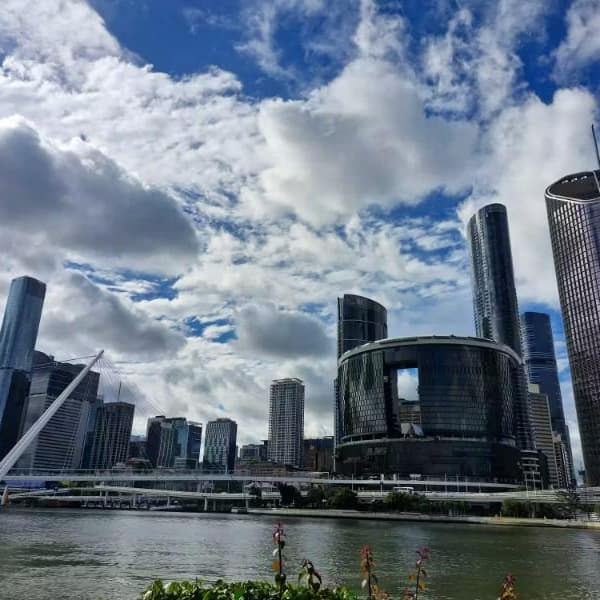
A busy city gives me more clues than it first appears
Architecture puzzles can look overwhelming because every part of the image contains detail. Windows repeat, streets cross, signs compete for attention, and small objects fill the foreground. Yet that density also gives me many anchors. A partial letter, a roof angle, a traffic light, or a line of reflected windows can identify a region more precisely than a broad patch of sky.
I begin by reading the city as a system. I identify the skyline, the main vertical structures, the strongest horizontal levels, and any road, river, bridge, or canal that moves through the picture. I then divide decorative detail from structural detail.
Structural detail tells me where a piece belongs. Decorative detail helps me finish the smaller region once its location is known.
I build a perspective map
Perspective makes parallel objects appear to converge. Roads narrow toward a vanishing point. Rows of windows become smaller in the distance. Roof lines change angle according to their position relative to the viewer.
In Paris Cafe, awning stripes, window frames, tables, and doorway edges create a network of straight lines. I compare both colour and angle. Two dark window pieces may look similar, but one contains a vertical frame while another continues a horizontal sill.
Venice Aerial has a different perspective. The canal acts as a route through the image, and building blocks sit around its bends. I trace the water first, checking the changing angle of each bank. Once the canal has shape, nearby roofs have a neighbourhood instead of an entire board of possibilities.
For Great Wall of China, the wall recedes through the landscape. Its apparent width and the direction of its edges indicate depth. I assemble towers and sharp wall boundaries before filling repeated stone texture.
I use windows as coordinates
Repeated windows are a classic source of difficulty, but they are not perfectly identical. I compare their size, spacing, frame colour, surrounding wall, and relationship to a corner or roof.
In a street-level view, lower windows may be larger and show more interior detail. Higher or more distant windows appear smaller and form tighter patterns. A window beside a building edge is more informative than one surrounded by an uninterrupted facade.
New York City and Singapore Marina both contain dense architecture. I avoid a single "windows" pile. I divide fragments into bright grids, dark glass, pale walls, rooflines, and corner transitions. If one tower has a distinctive tint or spacing pattern, it receives its own group.
I also look at what is reflected in glass. A blue patch on a building may be sky reflection rather than open sky. A straight frame line or subtle change in surface texture reveals the difference.
I assemble signs as miniature puzzles
Signs and text are valuable because letter shapes are distinctive. In Times Square, I treat each large billboard as a small puzzle. I group pieces by background colour, then connect partial letters, borders, faces, and graphic elements.
A bright white fragment could belong to dozens of signs, so I do not sort by brightness alone. I ask whether the white shape is a letter, a light source, a window, or a reflection. Curves, stroke thickness, and neighbouring colours make that classification possible.
Night Market contains smaller signs and lanterns. I begin with the largest color blocks and the clearest horizontal stall edges. Tiny writing is useful later, after I know which stall or sign it belongs to.
The same method applies even when I cannot read the language. Letterforms still have orientation, spacing, and stroke patterns. I use them as shapes rather than guessing their meaning.
I separate permanent structure from moving street detail
Cars, people, chairs, market goods, and street lights can make the lower part of a city scene crowded. I first establish the stable framework: road edges, building bases, pavements, counters, or bridge rails.
Then I attach smaller objects to that structure. A person is easier to place when I know which pavement remains empty. A cafe chair becomes useful when its legs align with the floor and table around it.
In Silver Train, the train body supplies a long mechanical boundary. I follow rails, window bands, and metallic highlights before working through the surrounding station or landscape.
For London Bridge, bridge lines connect architecture and open space. I look for the repeating rhythm of supports and the contrast between solid structure, sky, and water.
I distinguish real light from reflections
Night-city puzzles often repeat the same light twice: once at its source and again on wet pavement, water, or glass. Reflections tend to stretch, blur, or break according to the surface.
In Brisbane City, water or glass reflections can echo building lights. I compare orientation. A building window grid has stable vertical and horizontal edges, while a water reflection is more distorted and often extends downward.
Warm lights do not all belong together. I separate signs, windows, street lamps, and reflections by shape. A tiny circular lamp behaves differently from a rectangular office window or a long streak on a road.
This distinction prevents a common mistake: building an attractive cluster of matching colours that cannot fit anywhere because its fragments come from several unrelated light sources.
I use the skyline to connect city and sky
The skyline is one of the strongest boundaries in an architecture puzzle. It joins the relatively simple sky to complex building tops. Antennas, domes, towers, roof slopes, and gaps between buildings make skyline fragments distinctive.
Tokyo Skyline benefits from this approach. I build the dark or illuminated silhouette before filling either the sky or the building interiors. The completed outline gives both regions a fixed border.
Rome Colosseum replaces the modern skyline with an irregular historic structure. Arches repeat, but the outer contour and broken stone edges reveal position. I separate complete arch curves, vertical supports, top edges, and surrounding ground.
For Sigiriya, the landmark rises from a natural setting. I treat the rock outline like a skyline and use the contrast between stone, foliage, and open sky to anchor the centre.
I work from structure toward ornament
My city sequence is consistent:
1. Find the outer border and major skyline. 2. Trace roads, canals, bridges, or long building edges. 3. Build distinctive signs and landmarks as separate clusters. 4. Sort repeating windows by building, size, and light. 5. Attach people, vehicles, furniture, and small street detail. 6. Finish reflections, dark gaps, and repeated background texture.
I do not need to follow this order rigidly, but it keeps the solve from becoming a search through unrelated detail.
My final check for difficult architecture
When progress slows, I ask whether I have described the piece precisely enough. "Brown building" is not precise. "Warm stone beside the left edge of a shadowed arch" is.
I rotate my attention across line angle, scale, material, light, and perspective. Architecture is designed around relationships, and a puzzle preserves those relationships in fragments. Once I use the city’s structure as a coordinate system, visual density becomes an advantage rather than noise.